Showing posts with label Sweets. Show all posts

Tuesday, 17 February 2015

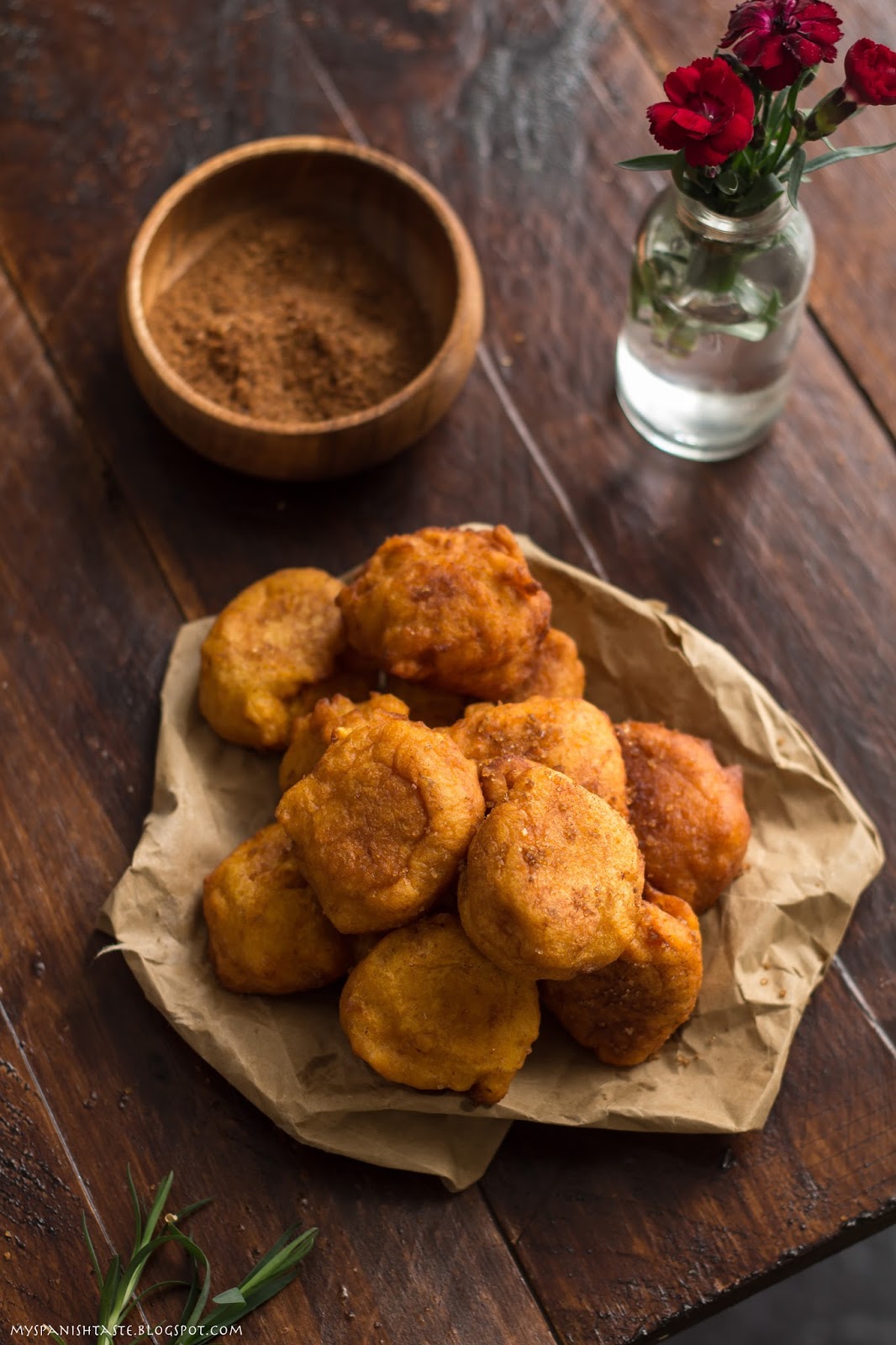
Mini sweet potato doughnuts, called buñuelos de boniato

Last Thursday before Lent is called in Poland Fat Thursday. Traditionally it is a day dedicated to eating large quantities of sweets, normally forbidden during Lent. Among the most popular served on that day are pączki (doughnuts filled with marmalade) and faworki. So, last Thursday I saw so many pączki on the Internet that, even if I'm not a huge fan of this kind of sweets, my desire to try one of them increased so much by the afternoon that I decided to look for them in La Donutería. Unfortunately, this afternoon they didn't have any filled one left, so I decided on the ring-shaped one. Despite the fact that it was really good, artisanal and made by a former pastry chef of famous patisserie Escribà, Mandarin Oriental Hotel in Barcelona and also Eleven Madison Park in New York City, it wasn't the same as Polish doughnut filled with jam:). Totally different, but also delicious, are Spanish buñuelos - savoury or sweet mini donuts, made of flour, milk, eggs and baking powder and then deep-fried in oil. To the sweet ones apples, pumpkin or sweet potatoes are sometimes added. They can also be filled with custard. The savoury ones can contain cod, shrimp, black pudding, cheese or cauliflower, for example.

Friday, 19 December 2014

Spanish Three Kings Cake: Roscón de Reyes

In Spain the night of 5 January is believed to be magic and exceptional, because during this night Three Kings come and bring the children (and not only) gifts - provided, of course, they were nice and well-behaved, if not, they will find coal under the Christmas tree (usually sugar or chocolate one)...

This night many cities in Spain organise Cabalgata de Reyes Magos, a traditional parade of kings. Gaspar, Melchor and Baltasar ride through the streets on camels and their page boys in specially prepared for the occasion and beautifully decorated coaches or trucks and they throw candies to children. It is also the right time to deliver the Three Kings a letter with a list of gifts they want to receive. When the night comes, just before going to bed, the children prepare hay and water for the camels, and milk, sweet wine, cookies or oranges for the kings. This is quite a restless night for the children, because very often they are so excited or even frightened by the fact that the kings on camels will come through the window of their house that its hard for them to fall asleep. The following morning they open the gifts that they have requested in the letter and then, for breakfast they have Roscón de Reyes, Three Kings Cake in the form of large ring, decorated with candied fruits and often with a layer of pastry cream, whipped cream or marzipan in the center. Roscones bought in pastry shops have a small surprises hidden inside. Generally it is a figure of one of the Three Kings and dry fava bean. Whoever finds the figure is crowned king or queen of the celebration and puts on his head a golden crown (paper crowns are normally sold with the cake), whereas whoever finds the bean should pay for the cake. 


Thursday, 27 November 2014

Rice pudding with chestnuts

Probably many of you have noticed that I'm not a sweet-toothed person, and when it comes to Spanish food I definitely prefer salty, savory dishes over sweets. So, there are only few recipes for traditional Spanish desserts on the blog, because I'm not really into flan, crema catalana, arroz con leche or natillas....well, maybe with the exception of rice pudding (arroz con leche). My first memories of this sweet rice are from already mentioned on this blog little family run hotel in Andalusian town Laujar de Andarax, where I spend some months at the beginning of my Spanish adventure, working and learning Spanish. Rice pudding was prepared there at least once a week. On these days I was waiting for the empty pot, to eat the remains of slightly burnt, dense and still hot rice pudding. This rice, often eaten with my finger, was absolutely the best:). This dessert is quite a filling one, so I do not recommend it straight after the main meal. For me, it tastes best for breakfast or with afternoon tea or coffee. I'm sure that eating it on empty or nearly empty stomach you will certainly appreciate its delicious taste:). 

Monday, 3 November 2014

Panellets: traditional Catalan sweets

Panellets are traditional Catalan sweets associated with All Saints day or the night before this day. In these days families and friends meet together and celebrate very popular festival called Castanyada, which consist of a meal of hot toasted chestnuts, sweet potatoes, panellets and sweet moscatel to drink. Panellets are made out of marzipan dough prepared by mixing together almond flour, potato or sweet potato and sugar. They come in many different shapes and flavors, although the traditional ones are small balls covered with pine nuts. You can also find them with coconut, chocolate or dried fruits. Traditional recipes for these sweets contain almost the same amount of sugar as almond flour, but for me these are simply to sweet, so this time I decided to add only 100 g of sugar per 250 g of almond flour. In addition to classic ones, rolled in pine nuts, I also prepared the coconut and chocolate ones.

Monday, 31 March 2014

Cream cheese flan with strawberry sauce

Flan is one of the most popular Spanish desserts. It is smooth, rich, creamy, sweet and not particularly low in fat. The classic one is a mixture of eggs, milk and sugar which is poured into the molds with caramel and then baked in water bath.  Milk, which is used to prepare a flan, is often flavored with vanilla, cinnamon and lemon zest. There are, of course, many mouthwatering variations of flan: with almonds, fruits, chocolate, coffee, cheese, yogurt, turrón or dulce de leche. There are also savory ones, which may contain fish, seafood, vegetables and so on. Today, however, being in a season for strawberries, I decided to prepare flan with cream cheese, covered with strawberry sauce with a hint of vanilla; instead of traditional liquid caramel.

Friday, 28 February 2014

Crispy pastries, bathed in honey syrup and flavored with white wine

Pestiños, is the name for the pastries presented in the title. They are usually prepared during Lent and especially during Holy Week (Semana Santa). As is usual with traditional recipes, there are almost as much recipes for pestiños as Spanish villages. Some add the anise seeds, some do not bath them in honey, but sprinkle them with sugar, and some do not prepare them for Lent, but make them for Christmas. Also at issue is their origin - some believe that they originate from Seville whilst others claim that they are from Cordoba. One thing is certain: these are Andalusian pastries, because not hard to notice that they resemble, flavorful and bathed in honey, Arabic sweets.


Monday, 17 February 2014

Avocado milk chocolate mousse tartlets

Today I propose very unorthodox tartlets: without baking, with no flour, eggs or fat, but with creamy avocado and milk chocolate mousse, which reminds me of the avocado shakes with a drop of chocolate sauce, which I discovered in Indonesia. Their crust is a combination of cocoa powder, dried dates, almonds, oat flakes and orange juice. They are not only very tasty but, as you may have guessed, also very healthy. Their taste and texture will definitely surprise - and I hope in a positive way - people with any knowledge of the ingredients used to prepare them. It just so happened that I made them on Valentine's Day, therefore the heart on one of them:), and I must admit I was a little stressed waiting for the reaction, but I quickly found out that quite unnecessarily, because the tart was approved just after the first bite and even praised with words: ''muy buena'', he said:). I saw the recipe on this site: http://angiesrecipes.blogspot.com, you will find many other very original recipes there.

Monday, 10 February 2014

Crispy orange - almond cookies

Crispy and flavorful cookies in the shape of tiles, called in Spain tejas (teja in Spanish means tile), are a great accompaniment to coffee or tea. Their only drawback is that they contain quite a lot of sugar, which when baking converts to caramel - and this in any way is the disadvantage of the cookies, but on the contrary, it complements their extraordinary taste. Apart from caramel, you can taste the abundance of orange flavor - thanks to the addition of orange juice and zest - and detect pieces of almonds, which give them extra crispness. 

Monday, 27 January 2014

Spanish anise doughnuts

Rosquillas are Spanish deep fried doughnuts with fluffy texture, traditionally prepared during the Carnival and Holy Week period. There are many types of rosquillas and many ways of preparing them. The most common ones are rosquillas de anís aromatised with anise liquor and rosquillas de vino to which, apart from anise, sweet muscat wine (moscatel) is added. Normally rosquillas are deep fried but some recipes show the healthier manner to prepare them in an oven, this one is not the case, I'm afraid:).


Wednesday, 22 January 2014

Baked bananas with cream cheese and dulce de leche

I will never forget the taste of banoffee pie which I was passionately picking at while working in one restaurant in England. Not that it was the best banoffee pie in the world, but because it was the first time for my taste buds. I was delighted by this unique combination of bananas and dulce de leche, and even though I didn't really like cream, in this excellent company it was also kind of delicious:).

Today's recipe resembles a bit banoffee pie. Consist of 4 levels: baked bananas, cream cheese with yogurt and a pinch of vanilla, walnuts and dulce de leche at the top :)