Wednesday, 4 March 2015

Brussels sprout salad

I have to admit that I definitely exaggerated with the amount of Brussels sprouts purchased few days ago at the market. As a result, last week I had them in almost every possible way: baked, boiled, steamed and fried. It's a shame I haven't hit before on an idea to prepare them in its simplest form - just raw:). After all, Brussels sprout is nothing else but a little cabbage, which I eat very often without cooking or frying:). This salad is based on ''what's in my refrigerator and kitchen cabinets'' and also on this recipe. I liked it so much that I've made it few more times since the first one. In addition to the Brussels sprouts I added to it some chopped walnuts and Spanish Manchego sheep cheese, which can be replaced by other firm ripened cheese. I served the salad with orange slices, which added juiciness and contrasted fabulously with distinctive and well developed flavour of the cheese (I love the combination of cheeses with fruits:)). I also sprinkled the salad with some dried cranberries and pour it over with the sauce made out of olive oil, lemon juice, honey and mustard. It's really delicious!!!.

Tuesday, 24 February 2015

Grilled vegetables with romesco sauce

You will probably agree with me that there are people who have really good ideas for enjoying their free time?. For example, there is this guy - Edu - who tries patatas braves in Barcelona and then rates them on his website: http://www.bravasbcn.com. He gives its price and the name and address of the bar or restaurant in which he has eaten them,  he evaluates the potatoes (their size, how they were prepared, whether they had a crispy crust, and were soft inside, if they were bathed in oil etc.) and also the sauces: alioli and tomato sauce (if were spicy, their texture, proportion between alioli and tomato sauce etc.). What intrigues me the most, however, is the list of 15 best patatas bravas in Barcelona, which is periodically updated. I must admit that I tried only few places from his list, but all of them were really delicious:). There are obviously many similar sites which evaluate restaurants, places with good coffee, with good carrot cake (recently very popular here in Barcelona), and also with spots for weekend brunch. Maybe I should think about this kind of site as well:). I could start with romesco sauce, very popular now when calçots are in season, which in many restaurants is also served with grilled or raw vegetables. I will definitely think about it:). Meanwhile, today I have for you this easy recipe for grilled vegetables with romesco sauce.

Tuesday, 17 February 2015

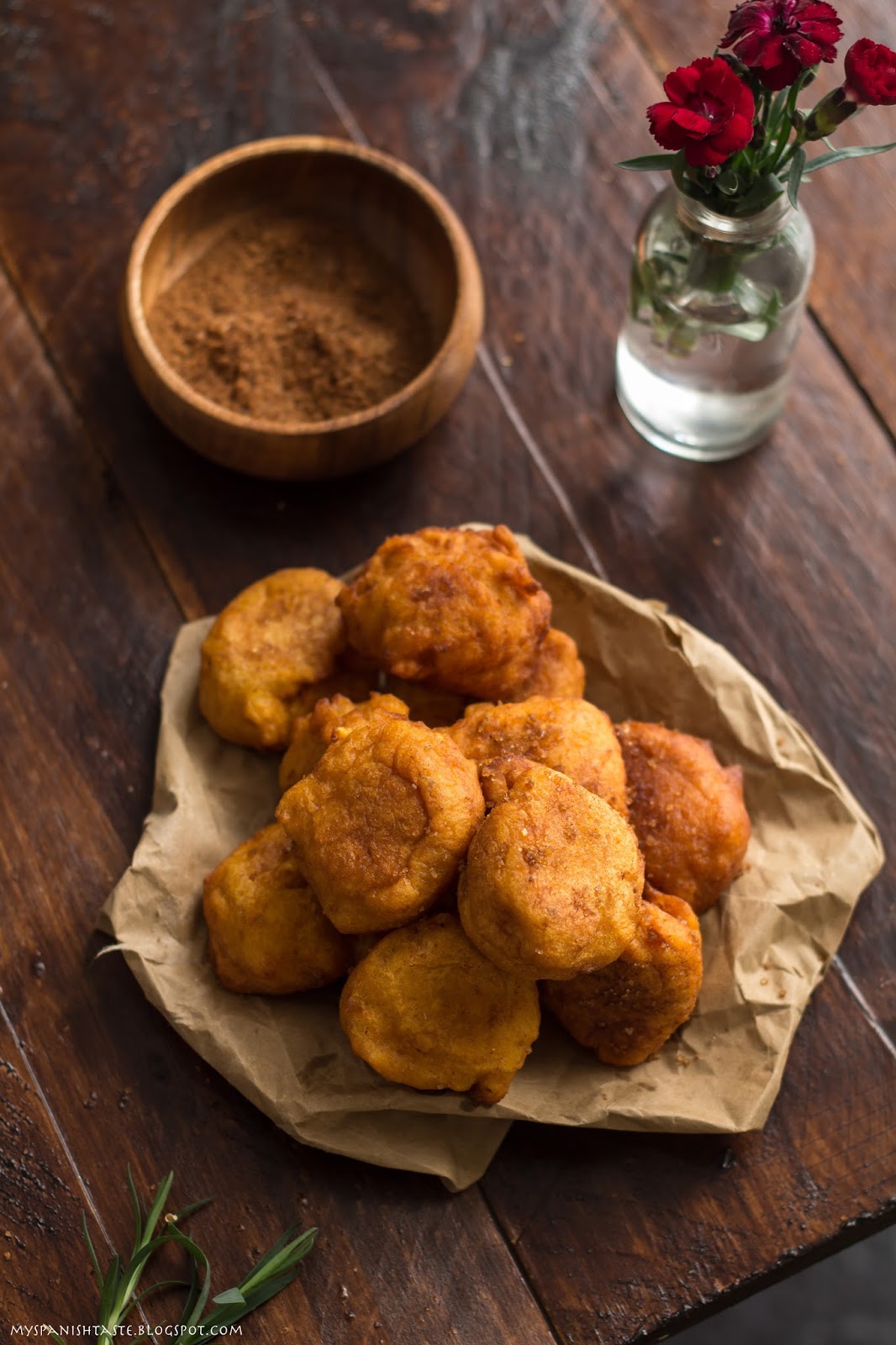
Mini sweet potato doughnuts, called buñuelos de boniato

Last Thursday before Lent is called in Poland Fat Thursday. Traditionally it is a day dedicated to eating large quantities of sweets, normally forbidden during Lent. Among the most popular served on that day are pączki (doughnuts filled with marmalade) and faworki. So, last Thursday I saw so many pączki on the Internet that, even if I'm not a huge fan of this kind of sweets, my desire to try one of them increased so much by the afternoon that I decided to look for them in La Donutería. Unfortunately, this afternoon they didn't have any filled one left, so I decided on the ring-shaped one. Despite the fact that it was really good, artisanal and made by a former pastry chef of famous patisserie Escribà, Mandarin Oriental Hotel in Barcelona and also Eleven Madison Park in New York City, it wasn't the same as Polish doughnut filled with jam:). Totally different, but also delicious, are Spanish buñuelos - savoury or sweet mini donuts, made of flour, milk, eggs and baking powder and then deep-fried in oil. To the sweet ones apples, pumpkin or sweet potatoes are sometimes added. They can also be filled with custard. The savoury ones can contain cod, shrimp, black pudding, cheese or cauliflower, for example.


Monday, 9 February 2015

Meatballs with artichokes and peas

Probably many of you will look at me in disbelief if I say that the last few days were probably the coldest ones in my life... This is precisely the charm of living in an apartment in the centre of Barcelona, where the the buildings are more than 100 years old, and although their beautifully decorated, modernist facades are clean and well maintained and the apartments in them are renovated, unfortunately most of them do not have a central heating. So normally we try to warm the flat with all types of electric heaters, and then we wait with fear for the electricity bill...I have to admit that it's not so bad in the night  - with a duvet pulled over my head, I'm actually very warm - but the worst is probably in the morning, just after getting up from a warm bed, when I turn on the heater which thermometer notifies me that the temperature in the apartment is, for example, 11,4 ºC!. Have you ever been so cold in your house?. Fortunately, today is a bit better:).

Hot meals are, of course, the best warm-ups, like today's meatballs in hot tomato sauce with artichokes and peas :).

Monday, 2 February 2015

''Galets'' pasta stuffed with cod and broccoli

To my surprise, I've noticed that there are many pasta based dishes in Spanish cuisine and this got me wondering: where did they come from?. I discovered that it was probably via the Arabs living in Andalusia long time ago. In the early thirteenth century water and flour based pasta with very strange names: fidawus, al-muhammis, zabzin or aletría had appeared in this part of Spain. 

In many traditional Spanish dishes pasta, just like rice, is cooked directly in sauces or soups, not separately in water. The most commonly used by Spaniards is pasta called fido. It can be bought in a variety of thicknesses marked with a number (fideo nº0, nº1, nº2, nº3, ...) and sometimes it has a hole along its entire length. This pasta is commonly used to prepare the dish called fideuá - very similar to paella, but with pasta instead of rice. Another popular pasta dish are canelones - sheets of pasta similar to those used to prepare Italian lasagna, which are folded into a tube and stuffed with meat, spinach or other vegetables; then are topped with tomato and bechamel sauce and baked in the oven (you can also buy the ready to fill canelones tubes). In Catalonia there is also pasta called galets that appears here especially during Christmas in traditional one-pot dish called Escudella i carn d'olla - a bit like cocido from Madrid. Normally this dish is eaten as two separate ones: first one is the broth served with galets stuffed with meat, and the second one contains all the ingredients, from which the broth was made: meat, sausage (botifarra), chickpeas, vegetables (cabbage, potatoes, carrots) and huge meatballs called pilotes

Galet pasta is similar in shape to snail shells, but with an opening on both sides. I must admit that it's a little complicated to fill it with the stuffing, so I recommend you use a large open shells instead of galets, if you want to prepare this cod and broccoli stuffed pasta.


Thursday, 22 January 2015

Sea bass with florence fennel and saffron

You probably agree with me that one of many positive things associated with Spain is the constant access to fresh fish and seafood and fresh vegetables and fruits. It's been almost 10 years since I moved here and during this time my everyday meals have become almost entirely dominated by sea creatures, vegetables and legumes, leaving behind meat, poultry and cold meat (excluding jamón serrano, because I just can't resist this delicious ham:)). When it comes to seafood the one I like the most is all kind of shellfish (mejillones, almejas, chirlas, lapas, navajas), in case of fish I mostly reach for sardines and sea bass. The last one is probably the most commonly eaten fish in our small family. Most frequently I simply bake it in salt, because this is the easiest and the fastest way; sometimes I just fry the fillets with a little bit of olive oil, garlic and parsley, and very rarely I serve it with some tasty sauce... like this one with florence fennel, saffron, young garlic, almonds and a hint of ginger, which I've seen in cooking show presented by the cook Julius Bienert.


Wednesday, 14 January 2015

Pumpkin and chestnut cream soup

Feliz año 2015, my dear friends!.

I know, I know that Christmas holidays are long gone, but I'm just now starting slowly to adjust to my daily rituals. Any break in the routine is undoubtedly very positive, indicated, welcomed and eagerly awaited, but then I need some days or even weeks to stick to the rhythm of a normal day...

Today's recipe for the soup has been waiting quite a few weeks for the publication... More than 3 weeks ago winter started and this soup is truly autumn one; but I hope that even though the season changed it won't be a problem to find pumpkin and chestnuts in your local markets or grocery shops. In any case, you can always keep the recipe until the next year, because it's really worth it:).

Friday, 19 December 2014

Spanish Three Kings Cake: Roscón de Reyes

In Spain the night of 5 January is believed to be magic and exceptional, because during this night Three Kings come and bring the children (and not only) gifts - provided, of course, they were nice and well-behaved, if not, they will find coal under the Christmas tree (usually sugar or chocolate one)...

This night many cities in Spain organise Cabalgata de Reyes Magos, a traditional parade of kings. Gaspar, Melchor and Baltasar ride through the streets on camels and their page boys in specially prepared for the occasion and beautifully decorated coaches or trucks and they throw candies to children. It is also the right time to deliver the Three Kings a letter with a list of gifts they want to receive. When the night comes, just before going to bed, the children prepare hay and water for the camels, and milk, sweet wine, cookies or oranges for the kings. This is quite a restless night for the children, because very often they are so excited or even frightened by the fact that the kings on camels will come through the window of their house that its hard for them to fall asleep. The following morning they open the gifts that they have requested in the letter and then, for breakfast they have Roscón de Reyes, Three Kings Cake in the form of large ring, decorated with candied fruits and often with a layer of pastry cream, whipped cream or marzipan in the center. Roscones bought in pastry shops have a small surprises hidden inside. Generally it is a figure of one of the Three Kings and dry fava bean. Whoever finds the figure is crowned king or queen of the celebration and puts on his head a golden crown (paper crowns are normally sold with the cake), whereas whoever finds the bean should pay for the cake. 


Tuesday, 9 December 2014

Squid with pasta in tomato sauce

Well, December has finally arrived. There is lots of festive meals recipes all around, but I still prepare the everyday ones (please forgive the breakout from the common trend). Perhaps I will disappoint a little some of you, but the truth is that for the last few years I've been out of Christmas culinary fever and apart from traditional Polish gingerbread cookies, I will not have the opportunity to prepare (or even to try) any other traditional Polish Christmas delicacies this year. I have to admit that I'm quite accustomed to the fact that on Christmas Eve there are shrimps and mussels instead of herring and carp on the table, and that there is also meat dish to be served (in Poland we don't eat meat on Christmas Eve). Quite normal becomes also the after Christmas Eve dinner meeting with friends and New Year's Eve dinner with family until the midnight and then the meeting with friends. From the beginning of December I'm eating turrons, especially the Jijona one and during the Christmas holiday season I'm going to eat truchas de batata (fried dumplings stuffed with sweet potato and almonds) for breakfast or with afternoon tea. I also look forward to try Roscón de Reyes: a traditional Spanish cake-style pastry with marzipan or cream filling in the centre (which can also be chocolate flavoured) eaten the morning of Reyes - King's Day -, which celebrates the Epiphany - 6th January - when the Tree Kings came to leave presents for the Christ child. This is the day that Spanish children open their Christmas presents (writing this I'm denying what I wrote in the previous post that I strongly prefer savoury dishes!:)....well, as you can see at Christmas, everything changes:).  

Thus, today, instead of Christmas recipe I have something for before or after Christmas: delicious squid with pasta in tomato sauce and cheery tomatoes.


Thursday, 27 November 2014

Rice pudding with chestnuts

Probably many of you have noticed that I'm not a sweet-toothed person, and when it comes to Spanish food I definitely prefer salty, savory dishes over sweets. So, there are only few recipes for traditional Spanish desserts on the blog, because I'm not really into flan, crema catalana, arroz con leche or natillas....well, maybe with the exception of rice pudding (arroz con leche). My first memories of this sweet rice are from already mentioned on this blog little family run hotel in Andalusian town Laujar de Andarax, where I spend some months at the beginning of my Spanish adventure, working and learning Spanish. Rice pudding was prepared there at least once a week. On these days I was waiting for the empty pot, to eat the remains of slightly burnt, dense and still hot rice pudding. This rice, often eaten with my finger, was absolutely the best:). This dessert is quite a filling one, so I do not recommend it straight after the main meal. For me, it tastes best for breakfast or with afternoon tea or coffee. I'm sure that eating it on empty or nearly empty stomach you will certainly appreciate its delicious taste:). 

Friday, 21 November 2014

Roasted chicken with sweet potatoes and mushrooms

This year's Catalan autumn is rich in mushrooms. I've heard that this year there are about 180 kg of mushrooms for every hectare of forest - a record from almost 20 years ago:). This is why I'm not surprised that they are all around, in every greengrocery and market, and also in my kitchen:). I eat them several times a week; sauteed in olive oil or butter with a hint of garlic and parsley, or I simply add them to meat and seafood meals or to soups. The second star of this year's autumn season in my kitchen is a sweet potato, which I add to the traditional lentil soup (instead of pumpkin), and which enrich the taste of other casseroles, stews or desserts. I have to admit that this year I haven't tried yet the roasted chestnuts - sold in Barcelona by street vendors - (probably because of very warm autumn), nor have I made any dish with chestnuts.... I'm going to get down to it very soon. Meanwhile, today I have for you a delicious roasted chicken with sweet potatoes and mushrooms:).

Thursday, 13 November 2014

Mackerel stew

In humid autumn days, which fortunately doesn't happen here very often, I fancy warming, one-pot meals that help me forget for a few hours about this unbearable, damp chill. The whole process of preparation the meal fills the kitchen with warmth and aroma of frying garlic and lightly toasted smoked paprika that stimulate the senses, warm my body and give me energy. One of this kind of dishes is popular in Catalonia and Valencia suquet - fish stew with aromatic sauce and vegetables. Was invented by fishermen who were trying to made the most of unsold fish or seafood while preparing their everyday meals. Traditional suquet, apart from fish or seafood, also includes potatoes, tomatoes and smoked paprika, which give the dish a characteristic red colour. The basis of this fish stew is rich in flavor fish broth prepared from fish heads and bones. Fish, which I added to today's stew is mackerel, which intense flavor harmonizes perfectly with very simple, but incredibly aromatic sauce of tomatoes and paprika.

Friday, 7 November 2014

Wild mushroom empanada

I would say that empanada is a huge baked dumpling or pie, and an older brother of empanadillas, which are small baked dumplings, popular in Spain and several South American countries. In Spain, the most popular are empanadas from Galicia. Their dough contains quite a large amounts of fat (lard or olive oil), flour and water; sometimes a liquid formed during the preparation of filling is also added to it. Fillings are quite varied: meat, fish, seafood, vegetables or mushrooms, but the basis of almost all of them is sofrito: chopped onions and green and/or red peppers fried in olive oil, to which grated tomatoes or tomato sauce is often added. Typical Galician empanadas are prepared in large circular baking tins. The dough should be rolled out quite thin into 2 circles - one for the bottom and the other on top of the filling. The sealing of typical Galician empanada is done by forming spiral shaped edges and its top is often decorated with dough strips. In the middle of almost every empanada you will find a small hole, which helps the empanada to ''breathe'' during baking. Normally it's cut into wedges, served hot or cold, as a snack or appetiser. 

Monday, 3 November 2014

Panellets: traditional Catalan sweets

Panellets are traditional Catalan sweets associated with All Saints day or the night before this day. In these days families and friends meet together and celebrate very popular festival called Castanyada, which consist of a meal of hot toasted chestnuts, sweet potatoes, panellets and sweet moscatel to drink. Panellets are made out of marzipan dough prepared by mixing together almond flour, potato or sweet potato and sugar. They come in many different shapes and flavors, although the traditional ones are small balls covered with pine nuts. You can also find them with coconut, chocolate or dried fruits. Traditional recipes for these sweets contain almost the same amount of sugar as almond flour, but for me these are simply to sweet, so this time I decided to add only 100 g of sugar per 250 g of almond flour. In addition to classic ones, rolled in pine nuts, I also prepared the coconut and chocolate ones.

Tuesday, 28 October 2014

Rice with rabbit and mushrooms

I explained a bit about Spanish dishes based on rice on the occasion of the recipe for Rice with octopus, broad beans and artichokes, today I invite you to try another rice dish. This time with very healthy and often underrated rabbit meat and mushrooms. The recipe comes from one of the television programs hosted by Spanish chef José Andrés (I'm sure lots of you know who I'm talking about), who has been leaving for more than 20 years in the USA and who contributed largely to disseminate Spanish cuisine among Americans. At this link you can see José Andrés in action, and below you will find my description of this delicious and warming one-pot dish.

Friday, 24 October 2014

Thick soup with codfish balls, pasta and vegetables

I must admit that I had a little problem with naming today's dish called in Spanish: Guiso de albóndigas de bacalao con aletría. The problem turned out to be two words: guiso and aletría. Spanish verb guisar means ''to cook'' or ''to stew''. For me a typical stew contains meat and gravy and is thicker then this dish, which looks more like a thick soup. So, after giving some thought to the matter today's guiso has become a thick soup. As to the second word, at first,  I did not have the slightest idea what aletría could means, then I read on the website of the author of the recipe that aletría is fideo gordo, which means short and thick pasta used mostly to prepare fadeuá (dish similar to paella, but instead of rice with pasta called fideos) and called aletría in Murcia Region. This is where this dish with codfish balls, pasta, potatoes, artichokes and peas comes from and which is just perfect for the upcoming cold days.

Monday, 20 October 2014

Meatballs in tomato sauce (Albóndigas en salsa de tomate)

When a few years ago I decided to start a blog, not for a moment did I think that I would get so much involved in cooking, photographing and writing the posts. From the begging, I decided that I would never force myself to do it. It so happened that during the last three months I took a break from blogging and instead of writing posts and photographing what I cooked, I preferred to cook just for my own pleasure; not only Spanish dishes, but especially those Polish ones, from my ''old'' years. Thus, my summer menu was full of cold soups with beet, potato dumplings (kopytka), stuffed dumplings (pierogi), cauliflower with butter and bread crumbs and beef roulades. Fortunately, after the storm comes the sun, and now, day by day, I'm more keen on looking for new Spanish recipes and of course on testing them. Today's recipe was tried out by me in late summer, when the stalls sagged under the weight of juicy, ripe and incredibly red tomatoes. Meatballs in tomato sauce is one of the classics of Spanish cuisine. You will meet them in tapas bars and also in restaurants serving traditional Spanish dishes.

Wednesday, 30 July 2014

Broccoli and feta cheese salad

Broccoli is not a vegetable which appears frequently in traditional Spanish dishes, but due to its high nutritional value is increasingly appreciated also in this part of Europe. Broccoli is often served here as a side dish for meat, seafood or fish, or is added to stews or salads. Today's salad inspired by a recipe I've found on a Peruvian kitchen website: www.yanuq.com, contains broccoli florets (cooked or steamed al dente), feta cheese, pine nuts and raisins. The sauce, which I used for the salad is basically mayonnaise mixed with natural yogurt; however, if you prefer less caloric version, I suggest  replacing it with just the yogurt or simply drizzle the salad with extra virgin olive oil mixed with a bit of vinegar.

Monday, 21 July 2014

Courgettes stuffed with chanterelles and serrano ham

I like wandering around the Boquería food market and look for vegetables or fruits, which I simply can not find in other places. Without doubt, this is where you can buy all sorts of weird edible things. I don't know if you realise that many Spaniards do not know what rhubarb or gooseberry look like, have no idea about the existence of redcurrants and do not distinguish blackcurrants from blueberries. Buying these fruits is practically impossible here, but sometimes at Boquería, there are such ''unusual things'' - last year, for example, I found there rhubarb; unfortunately its price: 10 euros per 1 kg, totally scared me off. During my last stroll through Boquería,  I found neither the currants nor the berries, but I noticed round courgettes, which are not common here at all. As soon as I saw them, I thought of stuffing them with chanterelles and serrano ham. So, with purchased courgettes I went straight to the stand with mushrooms. Finally, I returned home with neither currants nor blueberries, but with excellent idea for delicious dinner:).

Tuesday, 1 July 2014

Rice with chard, white beans and snails

I hope that the snails in the title haven't scared you off:), but if you don't feel like eating snails, I assure you that this dish tastes just as well without them. However, one thing is certain: snails add the character to this rice dish:). So, the choice is yours:). I've always associated snails with French cuisine and I was quite surprised to see that also Spaniards appreciate their taste and that snails is a key ingredient in many traditional Spanish dishes. They are often added to dishes with rice, combined with rabbit, tuna, cod or a quail meat. Snails are also served with a variety of sauces, often with a spicy tomato sauce; or can be simply stuffed with a garlic-parsley butter. The most delicious snails I've ever tried, however, are those from Seville, where - in almost every tapas bar - snails are served with a little bit of delicious broth - during my 3-day stay there, I ate them 3 times and they had always been delicious:). Apart from the land snails, in Spain also sea snails are eaten, e.g. the Galician small, gray-black ones called caramuxos or Mediterranean cañaillas, larger than the land ones.